


Learn to overcome language barriers with confidence and skill, so that more speakers of English as a Foreign Language can participate in research.
As a researcher, you know it’s important that everyone has access to innovative treatments. You want to include racially minoritised people in your research, many of whom speak English as a Foreign Language. You’re aware that if participation does not reflect the population you serve, it will be noticed.
But overcoming the language barrier feels intimidating.
‘Of the electronic referral letters sent to patients by NHS England last year, more than 9% had to be translated into a foreign language, according to figures disclosed by the Government under transparency rules.’ The Telegraph, Feb 15th 2025
How can you include people who do not speak English fluently?
Many research conversations happen at stressful moments. A patient may already be processing a diagnosis, a care plan, or new treatment information. Then someone approaches them with the option of participating in a study.
Even when someone speaks “good English”, research language can be hard to follow. Terms like Informed Consent, Clinical Trial, random allocation, and control group can sound confusing or intimidating if they are not explained carefully.
Add a jargon-heavy patient information sheet that has not been written with accessibility in mind, and the outcome might be one of two things:
Neither outcome supports meaningful consent.
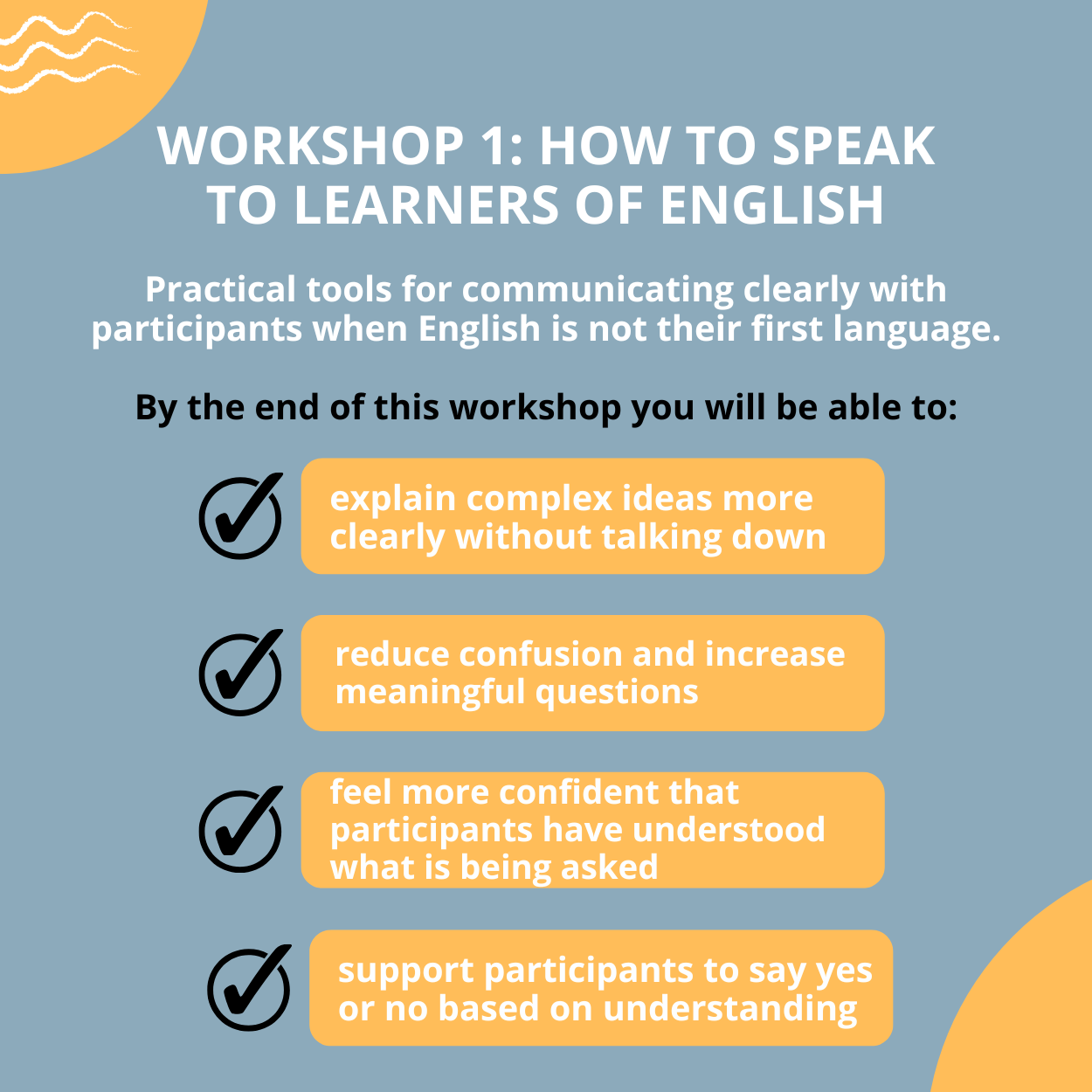
When communication improves, participants are more likely to understand what they are agreeing to, and more likely to ask questions. Interpreters can transfer your meaning more reliably. And people can say yes or no for the right reasons.
Clearer communication can help you:
I’m the founder of English Unlocked and for 25 years I taught English to people from all over the world, including asylum seekers and other migrants. I became highly skilled at adapting my speech so that even beginners could understand me.
Since 2018 I’ve been sharing these skills with staff who need to be understood by speakers of English as a Foreign Language. Clients tell us that after our training, conversations become calmer and more interactive. Written communication becomes clearer and more engaging, not just for those whose first language is not English, but for everyone.
In 2020 I teamed up with leading interpreter Marta Leigh to provide training on how to get the most out of interpreter services. We authored NIHR guidance on How to calculate the costs of involving interpreters and translators in health and social care research.
Watch the video for a tip from our workshop on how to work effectively with interpreters
(NHS Health Research Authority 2023)
After attending, you can expect:
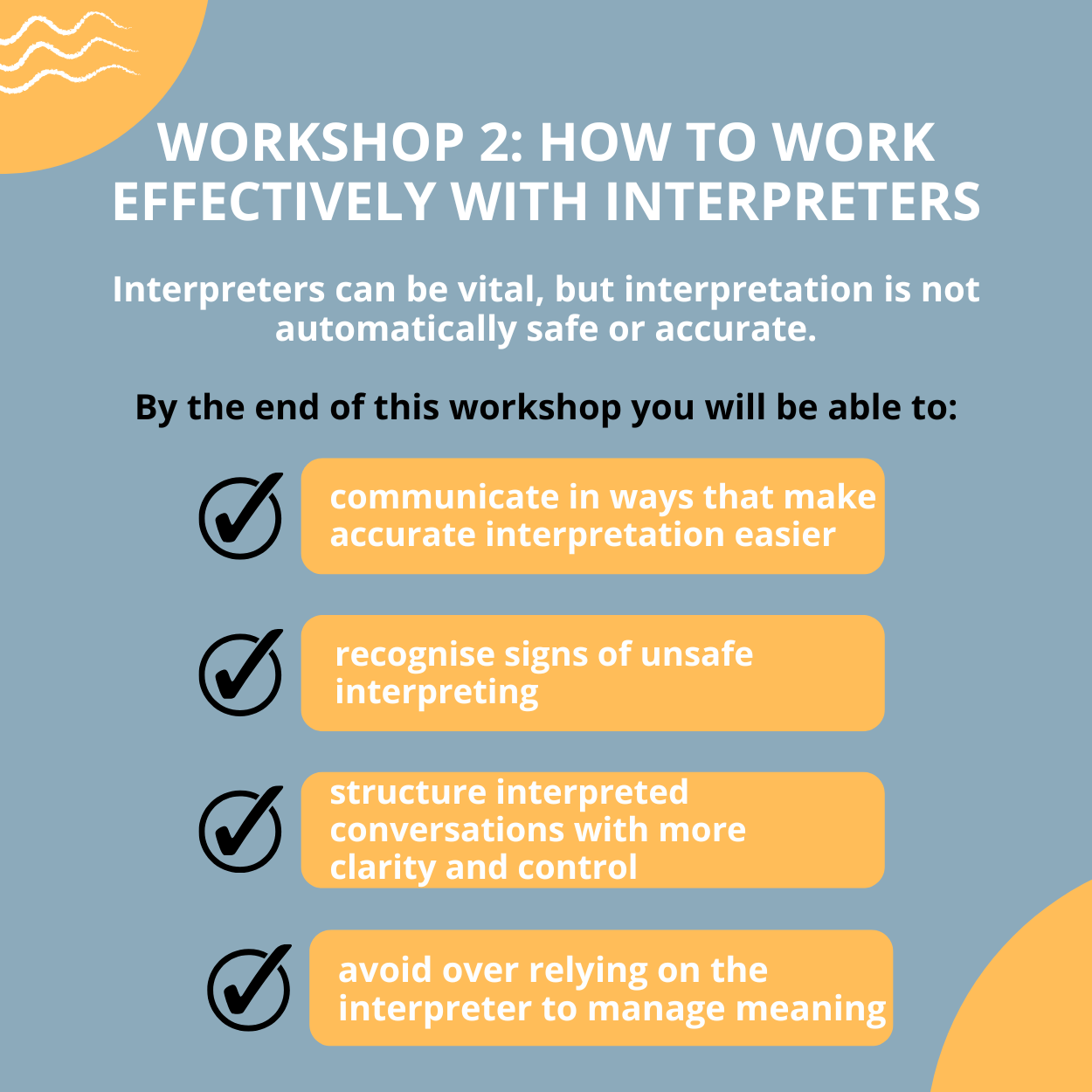
It is common to assume an interpreter will solve the problem. But not everyone working as an NHS interpreter understands key research terminology like Informed Consent or Clinical Trial. Many interpreters are untrained.
This matters because if the interpreter does not fully understand the concepts, meaning can shift without anyone realising. Without clear communication from you, consent can become meaningless.
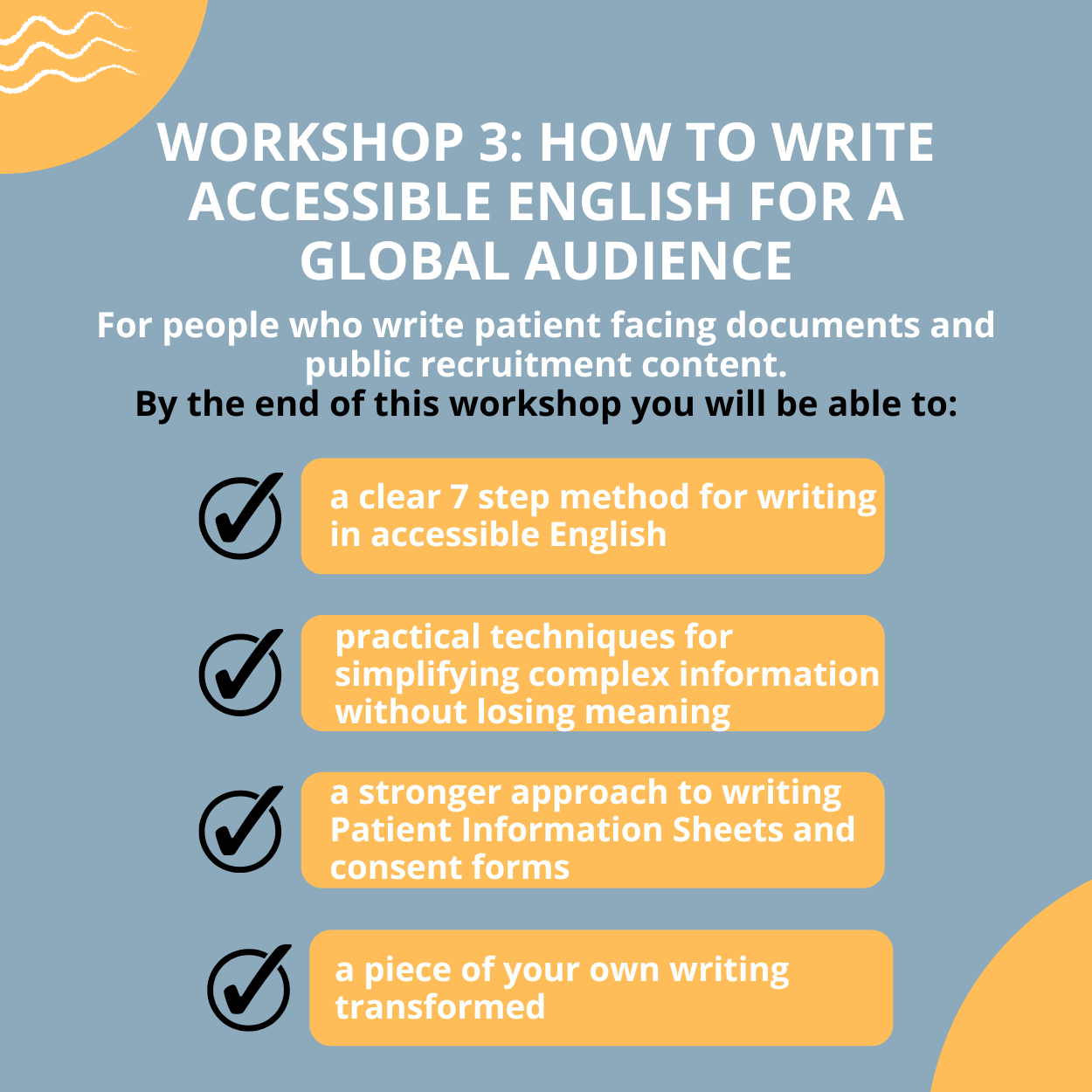
If you recruit and consent participants, workshops 1 and 2 are the core combination. If you write participant facing documents or recruitment content, workshop 3 is especially relevant.
✔️ Each workshop lasts 2 hours.
✔️ Up to 20 participants per session.
✔️ Workshops can be delivered individually or as a full series.
✔️ Face-to-face or online
✔️ Prices for groups range from £600 to £800 depending whether a consultation to develop bespoke training is required.
✔️If it’s just for you, we’ll put you on a waiting list. You’ll receive a notification when the next session is taking place.
“Amazed at how much was covered in such a short space of time. Will change the way I write posts from now on, for everyone.” Justine Smith, NIHR
If you recruit and follow up with participants, the first two workshops are core training.
If you recruit public members or write participant-facing materials, the writing workshop is strongly recommended.
In a bespoke workshop funded by NIHR, we helped PPI leads rethink the way they wrote social media posts to recruit public members.
They recognised that without a racially diverse Steering Committee, it is much harder to run inclusive trials. Social media was one of the tools they used to recruit public members, and we found lots of room for improvement in typical recruitment posts.
We delivered a short, impactful online workshop focused on writing posts that were more accessible and more engaging, without losing accuracy or professionalism.
“Amazed at how much was covered in such a short space of time. Will change the way I write posts from now on, for everyone.”
Justine Smith, NIHR
Find answers to some of our most commonly asked questions below
All our workshops are 2 hours long.
Yes. We can deliver the workshop online or in-house. Depending on your location, in-person training may incur a small additional cost.
Workshops 1 and 3 and delivered by our founding director, Shelley Purchon. Workshop 2 is delivered by leading interpreter Marta Leigh.
No, we also deliver training to individuals, who can book on to mixed-group sessions. These sessions don’t focus on health and social care research, the tips are more generalised to staff in a wide range of roles. To find out more, request a mixed group session when you click on ‘Enquire now.’ In our reply we’ll let you know which workshops we have coming up, and we’ll add your name to the waitlist if nothing is scheduled already. Prices start at £60 per person.
Yes. Bespoke workshops include a consultation before and after the workshop.
Yes. The workshops are popular with staff in a range of professions, everything from employability advisors to social workers to midwives. If you need the training to focus on something other than research, let us know.
It has an added element which others don’t have: insights into what’s confusing about the English language for the global majority. Some of the vocabulary recommendations made by the Plain English campaign don’t actually work for a global readership. We explain this in workshop 3, and provide guidelines to help you write Plain English that’s easier for everyone, not just for those who grew up speaking English.
Yes. The session is interactive, visual and practical, with plenty of examples, opportunities to try techniques and space to ask questions.
Sign up for our bulletin, providing free resources, industry news and training opportunities once a month
Please complete the form below, and we will be in touch to discuss your training requirements.
5.0Top Rated Serviceverified by TrustindexTrustindex verifies that the company has a review score above 4.5, based on reviews collected on Google over the past 12 months, qualifying it to receive the Top Rated Certificate.